
Orange County Nursing Home Abuse Lawyer
Take advantage of our free, private case review offer! Simply fill out the form or call us at (949) 640-8222 to schedule your consultation.






Nursing homes and long-term adult care facilities are meant to be secure, supportive environments for elders and other dependent adults. If the premises are allowed to become unclean or unsafe, or if the staff is not properly vetted and supervised, your vulnerable family member could be seriously harmed.

At Hodes Milman, our attorneys are dedicated to protecting the rights of all our clients and their family members. This is especially true for the most vulnerable in our community, like the ill and nursing home residents. In pursuing justice for your case, we seek the improvement of safety standards in all long-term care homes.
Legal action could result in requiring the nursing homes to improve their policies and practices or remove negligent actors. By reaching out today, you could help improve the quality of your loved one's life and the well-being of other patients or residents around them.
If you are ready for legal representation, contact us online or call us directly at (949) 738-9840 to learn how an Orange County nursing home abuse lawyer can support you and your loved one.
“When a family places someone they love in a nursing home, they're trusting that facility to provide the care and attention their loved one needs. Discovering that someone has been neglected or mistreated is devastating. Our job is to find out what happened, who was responsible, and what it will take to hold them accountable.”

Why Hire Our Nursing Home Abuse Law Firm in Orange County
At Hodes Milman, we set out to give a voice to those who are often silenced. We believe every nursing home resident deserves dignity, respect, and the highest standard of care. For over 30 years, the attorneys at Hodes Milman have fought to make Southern California a safer place, especially for the elderly.
We are proud to champion the rights of older patients and have fought for justice in cases where negligence has caused significant harm, securing over $400 million in victories for our clients, including:
- $150,000 Settlement: After a nursing assistant mishandled a transfer, an 89-year-old man suffered a femur fracture and required additional surgery.
- $2.4 Million Settlement: A 71-year-old man suffered a brain injury when nurses failed to monitor his vital signs during a transfusion.
Just because a person is dependent on nursing home care does not mean they are powerless. An Orange County nursing home neglect attorney at our firm is here to offer you support and guidance during this challenging and uncertain time.
Call Hodes Milman today at (949) 738-9840 or contact us online to learn about you and your family member's next steps.
What Types of Negligence Can a Nursing Home Abuse Lawyer in Orange County Help With?
Nursing home abuse isn't limited to just physical violence. It can take many different forms, from verbal mistreatment to financial exploitation. Neglect and abuse in nursing homes can show up in many ways you might not expect, so if you suspect anything is amiss with your loved one in a nursing home, you should consult with an Orange County nursing home abuse attorney.
Below are a few examples of how nursing home abuse can manifest:
- Verbal: Insulting or berating patients who cannot reliably report their abuse.
- Physical: Pinching, flicking, smacking, punching, burning, shoving, tripping, or any other form of physically injuring residents.
- Financial: Stealing or conning individuals out of their money or possessions.
- Sexual: Any sexual comments, touching, assault, or forms of humiliation involving nudity.
- Neglect: Failing to properly clean, medicate, and exercise patients in need of care is also abuse. Neglect in nursing homes can lead to infections, worsening conditions, bedsores, and other forms of injury that could lead to death if not caught in time.
Residents of nursing homes and adult care facilities do not only include those who are physically dependent. They often house people with cognitive conditions like Alzheimer's disease, dementia, and stroke survivors as well. Mental illness is also present in patients with diagnoses such as schizophrenia, bipolar disorder, anxiety, and depression.
Taking advantage of individuals who are already in need of care is an unacceptable breach of trust, professionalism, and humanity. Contact Hodes Milman to hold negligent nursing homes accountable and recover the financial resources your family needs to heal.
"I am from North Orange County, and most people up here only have the best things to say about Hodes Milman. They handle catastrophic personal injury, nursing home abuse, wrongful death, and fraud cases to fight against corruption. Based upon my personal experience, I highly recommend Hodes Milman to anyone who sustains injury and needs top-notch litigation and passion for justice on their side."
— Alexander N.
Laws Concerning Nursing Home Abuse in California
California has laws to protect nursing home residents from abuse and neglect. The state's Elder Abuse and Dependent Adult Civil Protection Act protects older adults and people who rely on others for their care. Abuse includes physical violence, emotional mistreatment, financial exploitation, and failing to provide basic care.
Nursing home residents have the right to receive proper medical treatment, live in a safe environment, be treated with dignity, and stay in contact with family members. They also have the right to report abuse without fear of punishment or retaliation.
When a nursing home fails to protect a resident, families can file a complaint with state health officials or pursue a lawsuit for injuries caused by abuse or neglect. A lawsuit can help recover compensation for medical bills, pain and suffering, and other losses.
Key Requirements for Nursing Facilities Under California Law
California law sets rules for how nursing homes must care for their residents. Nursing homes must provide:
- Enough staff: Having enough trained caregivers to meet residents' daily needs.
- Help with personal care: Assisting residents with bathing, dressing, and staying clean.
- Proper meals: Providing enough food and water, including meals for residents with special diets.
- A clean, safe environment: Keeping bedrooms, bathrooms, and common areas clean and safe.
- A way to call for help: Making sure residents have working call buttons to reach staff.
- Activities: Offering social and recreational activities that residents can enjoy.
Nursing homes that accept Medicare or Medi-Cal must follow additional federal rules.
When nursing home staff ignore calls for help, leave residents in soiled clothing or bedding, or fail to provide enough food and water, residents can become seriously ill or injured. Poor care can lead to bedsores, infections, dehydration, and hospital stays.
What Evidence Can Help Prove Nursing Home Abuse or Neglect?
A nursing home might blame an elderly resident's injuries on their age, poor health, or an existing medical condition. But what if your loved one developed severe bedsores after being left in bed for hours without assistance? Or suffered repeated falls despite needing help to walk?
In a nursing home abuse case, the question is how the facility's actions, or failure to provide proper care, contributed to the resident's injuries. Medical records, staffing information, and other evidence help establish what happened.
Some of the most important evidence includes:
- Medical records: Records showing when injuries first appeared, how they progressed, and whether treatment was delayed.
- Care plans: Written instructions explaining what assistance the resident needed, such as help walking, taking medication, or changing positions in bed.
- Staffing and facility records: Information showing who was responsible for the resident's care, if shifts were understaffed, and if previous complaints had been reported.
- Photos and videos: Pictures of bruises, bedsores, unsanitary rooms, or other conditions that show how the resident was being treated.
- Witness statements: Accounts from visitors, other residents, or employees who saw what happened or noticed changes in the resident's condition.
- Medical expert opinions: An evaluation of the connection between the injuries, the care provided, and the resident's existing health problems.
A facility's records might show that a resident was checked and repositioned regularly, while hospital records document an advanced bedsore. Examining when the injury developed, who was responsible for the resident's care, and how closely staff followed the care plan helps establish the cause of the injury and any failures in care.
Families can also document their concerns by photographing visible injuries, keeping copies of medical paperwork, and recording dates and conversations with nursing home staff. These details are valuable when questions arise about how long an injury went untreated or if the facility knew about a problem before the resident's condition worsened.
Who Can Be Held Responsible for Nursing Home Abuse?
When abuse or neglect occurs in a nursing home, several people or organizations can be held responsible for a resident's injuries, including:
- Nursing home owners and operators: Hiring unqualified employees, allowing unsafe conditions, or failing to provide enough staff.
- Administrators and supervisors: Ignoring complaints about mistreatment or allowing employees with a history of abuse to continue caring for residents.
- Nurses and caregivers: Giving incorrect medications, leaving residents unattended, using excessive force, or ignoring requests for help.
- Outside healthcare providers and contractors: Injuring residents during medical treatment, transportation, or other services.
For example, a caregiver drops a resident while moving them from a wheelchair to a bed. The resident's care plan states that two employees must assist with transfers, but the nursing home regularly schedules only one caregiver. In this situation, both the employee and the nursing home could be held responsible for the injury.
Under California law, nursing homes can also face legal action for violating certain resident rights, including protections related to their care and safety.
What Is the Most Common Abuse in Nursing Homes?
According to the World Health Organization (WHO), as many as 10,000+ abuse complaints are filed by or on behalf of nursing home residents each year. Here are the statistics on reported nursing home abuse incidents:
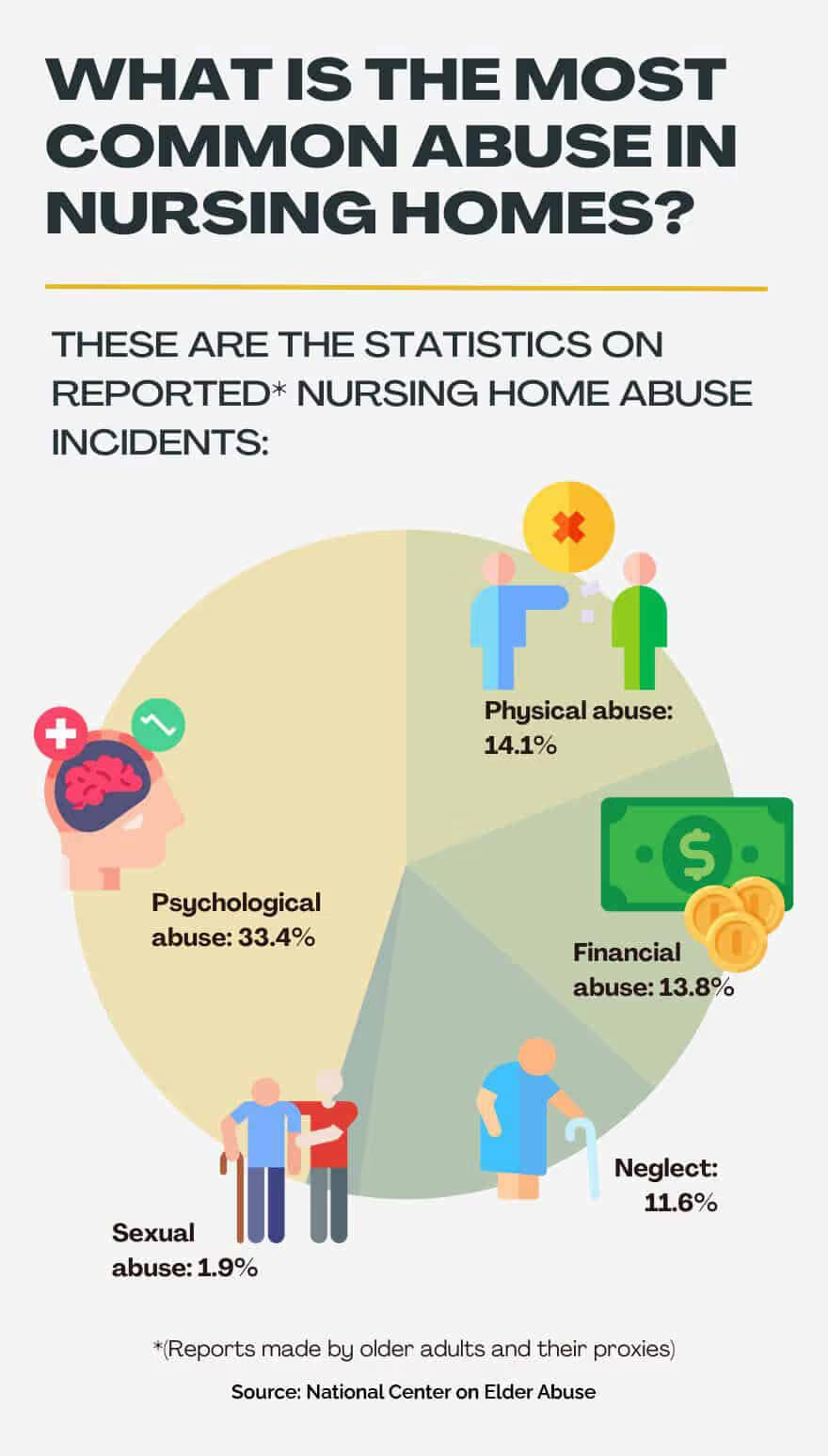
Psychological abuse has the highest percentage of reports, suggesting that there may be casual verbal harassment and torment from perpetrators. However, it's important to understand that the true scale of nursing home abuse is likely much higher than what we see in studies.
For every case of nursing home abuse that gets reported, experts believe there are about 24 more that go unnoticed. This underreporting happens for many reasons, including seniors fearing retaliation from the person abusing them, feeling too ashamed to speak up, or even worrying about being moved to another facility.
Sometimes, physical or mental limitations make it impossible for residents to report what's happening. So, while the numbers we see are concerning, they don't tell the full story, and sadly, the nature of nursing homes means there are many opportunities for private, unmonitored interactions with residents.
Any indication of abuse or signs of discomfort in your family member should be fully investigated and reported.
If you have reason to believe your loved one is suffering nursing home abuse, get in touch with Hodes Milman today online or by calling (949) 738-9840 for a 100% free case evaluation to see if an Orange County nursing home abuse attorney can help you and your family.
How Much Can an Orange County Nursing Home Neglect Lawyer Help Me Recover?
The settlement or damages awarded in nursing home abuse cases can help you move your loved one to a safer situation. It can also help pay for therapeutic care related to their injuries or replenish the funds that were robbed from them.
In a nursing home abuse settlement or verdict, compensation may cover:
- Medical costs for any hospital stays, ambulance transportation, medications, or specialist consultations.
- Lost income on the part of you and your family if you had to take time off work to investigate abuse suspicions, move your loved one out of a dangerous situation, or take on their care personally.
- Pain and suffering caused to the nursing home resident, like physical pain or psychological suffering that could impact their fragile health. This also could include the stress and grief you may have personally experienced while helping them.
- Financial repayment for missing funds or stolen property like jewelry, electronics, antiques, heirlooms, or medical equipment.
- Punitive damages, which are fees that a judge may order as punishment for the wrongdoers in your case and then award to you.
- Another area of compensation could come from a wrongful death claim if the abuse or injuries led to your loved one's death.
Not only can an Orange County nursing home abuse lawyer help you in calculating the full extent of damages for your loved one and you, but they can also improve your chance of success in a claim.
For example, a recent Martindale-Nolo study discovered that over 90% of readers with legal representation secured a settlement or award, while only roughly 50% of those who managed their injury claims independently achieved the same outcome.
California Nursing Home Statistics
Orange County is home to over 450,000 adults aged 65 or older, making up about 14% of the population. As more people reach retirement age, this number is expected to grow even more, reaching 17% by 2045.
With this increase, nursing homes in the area will see more residents, which also means there's a greater need for vigilance when it comes to preventing and addressing neglect or mistreatment in care facilities.
Furthermore, California is one of the leading states with the highest numbers of residents in certified nursing facilities. Around 110,000 Californians live in about 1,300 licensed nursing homes, and about 150,000 people live in approximately 7,500 licensed residential care facilities for the elderly. In addition, another 150,000 or more people are believed to live in unlicensed assisted living facilities, which may not always have the proper care they need.
Nursing homes in California are closely monitored by state and federal agencies to ensure they meet strict standards for resident care and safety. The Department of Public Health conducts annual inspections of all licensed facilities, checking everything from daily operations to resident care, with multiple surveyors involved in the process. Facilities that accept Medi-Cal or Medicare must meet even stricter rules.
However, even with all these regulations, some cases of neglect or mistreatment can still slip through the cracks, leaving nursing home residents at risk.
Resources to Help Those Impacted by Nursing Home Abuse
If you're concerned about a loved one's treatment in a nursing home, several organizations can help you report suspected abuse, file a complaint, or find information about residents' rights.
- Orange County Long-Term Care Ombudsman: Helps residents and families with complaints about nursing home care, neglect, abuse, and residents' rights.
- California Department of Public Health: Accepts and investigates complaints about nursing home care, abuse, neglect, and misconduct by facility staff.
- California Long-Term Care Ombudsman Program: Helps residents and families resolve complaints about nursing homes and other long-term care facilities throughout California.
- Eldercare Locator: Connects families with local services for older adults, including agencies that handle reports of elder abuse.
- National Center on Elder Abuse: Provides information about recognizing abuse, protecting older adults, and finding the appropriate agency to contact.
These organizations can help you report suspected abuse, investigate complaints, and find support for your loved one.
However, filing a complaint does not recover compensation for injuries or financial losses. If your loved one has suffered harm because of nursing home abuse or neglect, a civil lawsuit is a separate way to hold the facility accountable and seek compensation for what happened.
If your loved one is in immediate danger, call 911.
Speak With an Orange County Nursing Home Abuse Lawyer at Hodes Milman
Finding out that someone you love has been mistreated in a nursing home is upsetting, and getting answers from the facility can be difficult. You want to know what happened, how your loved one was injured, and why the people responsible for their care failed to protect them.
For more than 30 years, Hodes Milman has helped Southern California families pursue justice after serious injuries caused by negligence and abuse. Our attorneys take the time to hear your concerns, investigate what happened, and pursue compensation for the harm your loved one has suffered.
Call Hodes Milman at (949) 738-9840 or contact us online for a free case evaluation.
Proudly Representing Orange County Residents

Dan Hodes treated me like a human being, not just another client. He showed me he cared by how hard he worked on my case.
My daughter was born with a disability due to doctor neglect. I emailed over 200 lawyers over a 2 year time span. I had ONE lawyer believe in my case and he worked with Jeff Milman over the next year helping build my case. Jeff won my case and I cannot thank him enough for believing in me!! He was so pleasant to work with and professional. I will forever be thankful to him and his team!
They are friendly and honest and fought for what they believed was best in our interest.
Orange County Nursing Home Abuse FAQs

When you're worried about the safety and health of your loved one in a nursing home, you shouldn't also have to stress about legal costs and fees to help them. That's why at Hodes Milman we work on a contingency fee, which means that you won't pay a cent unless we win your case.
Yes, abuse is not limited to physical or verbal harm, it can also take the form of financial transgressions. Stealing money, property, and information, such as in cases of identity theft, are all forms of abuse as well as crimes.
Yes, it can be. Under normal circumstances, individuals are largely responsible for their own actions. However, for resident-on-resident abuse, the bad treatment could be coming from a person who isn't in control of their actions (as with mental illness), and should be prevented, stopped, and/or immediately remedied by staff. A failure to protect residents from themselves and each other is unacceptable.
Nursing home abuse or neglect may be indicated by symptoms such as:
- Bedsores
- Weight loss
- Unexplained injuries
- Mental withdrawal
- Other sudden changes in behavior or appearance
However, it must be noted that these conditions don't always point to abuse or neglect. To protect your loved one, you should make frequent visits to the facility to monitor his or her care. While there, note any unusual occurrences or changes in behavior and report your concerns to the administrator or supervisor.
For further aid in investigating your suspicions, contact our nursing home abuse lawyers online by calling (949) 640-8222.
Proudly Representing California Residents
Your life changed in an instant. Getting justice shouldn’t wait. Connect with Hodes Milman today and put a proven team to work on your case.